Stainless Steel Mesh Gloves and Aprons for Meat and Fish Processing
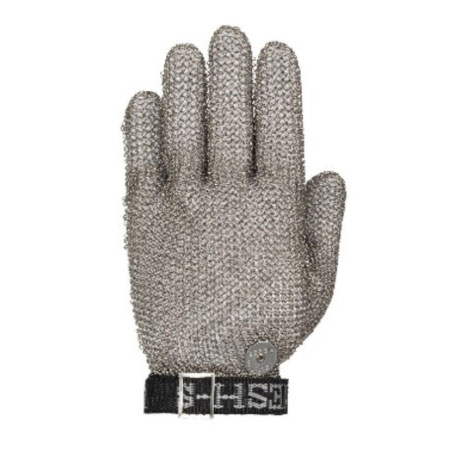
In butcher shops and meat, poultry and fish plants, a sharp knife can slip in an instant. Stainless steel mesh gloves, often called chain-mail gloves, are the standard protection for the hand that holds the product. Mesh aprons protect the torso during boning and deep cuts. Here’s how to choose and use them.
How mesh protection works
Mesh gloves are made of thousands of small interlocking stainless steel rings. A blade can’t slice through the rings, so a slip that would cut skin is stopped at the surface. Stainless steel resists corrosion in wet, salty work, and it can be cleaned and sanitized after every shift.
Wear it on the hand that holds the product
The mesh glove goes on the non-knife hand, the one that holds and steadies the meat or fish. That’s the hand at risk when the knife slips. Mesh gloves are sold as single gloves, so you buy one for each worker’s holding hand.
Wrist length or forearm length?
| Glove | Choose it for |
|---|---|
| US Mesh® Stainless Steel Mesh Glove with Adjustable Strap – Wrist Length | Slicing, trimming, filleting, deli work and oyster shucking |
| US Mesh® Stainless Steel Mesh Glove with Adjustable Snap-Back Strap Closure – Forearm Length | Boning and deep cuts toward the body, where the blade can travel past the wrist |
Both come in eight sizes, from XXS to XXXL. A good fit matters: a glove that’s too loose shifts on the hand and lets the knife reach skin, and one that’s too tight is tiring to wear.
Protecting the body: mesh aprons
When cutting toward the body, as in boning, a slip can reach the abdomen or thigh. The Stainless Steel Mesh Apron with Adjustable Elastic Strap is made of welded rings of 316L surgical-grade stainless steel and protects the torso against cuts, stabs and punctures. It should cover from the chest to below the groin and sit snugly, so it doesn’t swing. Adjust the straps before every shift.
Hygiene and grip
Many cutters wear a thin nitrile glove over the mesh. It improves grip on slippery product and keeps the work cleaner. Heavy 8 mil gloves such as Diamond Shield Nitrile Disposable Gloves Orange are popular for this, and the bright orange is easy to spot if a piece goes missing. Under the mesh, a knit liner such as Fisherman String Knit Gloves adds comfort and a little warmth in cold rooms.
Cleaning and inspection
- Wash and sanitize mesh gloves and aprons after each use, following your plant’s sanitation procedures.
- Check for broken or missing rings and damaged straps before each shift. A gap in the mesh is a gap in protection.
- Repair or replace damaged mesh straight away.
- Give each worker their own glove, sized to fit, rather than sharing.
Important limits
- Not for powered machinery. Mesh gloves are for hand knives. Never wear them near band saws, slicers with moving blades or other powered cutting equipment. Metal mesh can be caught and pulled in. Follow the machine’s own guarding and lockout rules.
- Not a replacement for knife skills. Sharp knives, a stable cutting surface and good technique prevent most cuts.
Lighter alternatives
For jobs with a lower cut risk, such as packing, trimming and handling sharp-edged packaging, cut-resistant knit gloves are lighter and cheaper. Examples are Cut-Resistance Gloves, Level A6 and Cut-Resistance Gloves Level A4, Micro Nitrile Coated Palm. Protect forearms with Cut-Resistance Arm Protection, Level A4. See cut levels A1 to A9 explained.
Complete the outfit
Meat and fish rooms are wet and cold. Add a waterproof apron or gown (see aprons and gowns for food processing), safety boots for wet work, and warm layers from our cold storage PPE guide. For a full list, see the food processing plant PPE checklist.