Earplugs and Hearing Protection at Work: A Practical Guide
Noise-induced hearing loss is permanent and builds up slowly, so most people do not notice it until it is too late. The good news is that it is easy to prevent. Foam earplugs are cheap, comfortable and very effective when they are worn properly.
How loud is too loud?
In Ontario, Regulation 381/15 sets a noise exposure limit of 85 dBA averaged over an 8-hour shift. Because of how sound energy adds up, every 3 dB increase halves the safe exposure time. 88 dBA is the limit for about 4 hours, and 91 dBA for about 2 hours. Employers must first try to reduce noise at the source. Hearing protection fills the gap where that is not enough.
A simple rule of thumb: if people have to raise their voices to talk at arm’s length, the area is probably loud enough to need a noise assessment.
Common noisy workplaces
- Food plants with grinders, bottling lines, compressors and conveyors.
- Woodworking, metal shops and fabrication.
- Construction sites and demolition.
- Warehouses with dock equipment, and commercial dish pits.
Choosing an earplug
| Type | Best for | Example |
|---|---|---|
| Uncorded foam | Steady noise all shift; lowest cost per pair | LittleEar Bullet Shaped Foam Ear Plug, Uncord, Orange |
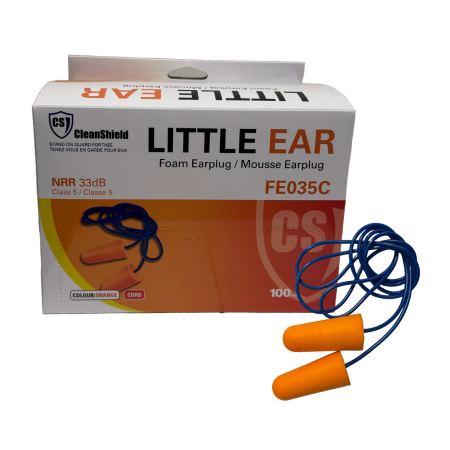
| Corded foam | People who take plugs in and out often; the cord stops them getting lost | LittleEar Bullet Shaped Foam Ear Plug with PVC Cord, Orange |
| Metal-detectable corded foam | Food and pharmaceutical plants with metal detectors | LittleEar® Metal Detectable Foam Earplug Cord Blue |
In food production, a lost earplug is a foreign-object risk. Metal-detectable plugs are blue, so they stand out against food, and they can be picked up by metal detection equipment on the line. See our food processing plant checklist for the rest of the foreign-object controls.
How to fit a foam earplug
- With clean hands, roll the earplug into a thin, tight cylinder.
- Reach over your head with the other hand and gently pull the top of your ear up and back. This straightens the ear canal.
- Insert the earplug well into the canal, and hold it there for 20 to 30 seconds while it expands.
- Check the fit: your own voice should sound deeper and muffled. If much of the plug sticks out, take it out and try again.
A badly fitted earplug can give only a fraction of its rated protection, so take a few minutes to show new workers how to do it.
Wear time matters
Protection only works while it is in. Taking earplugs out for even a short time in a very loud area wipes out much of the benefit over a shift. Corded plugs make it easy to let them hang and put them back in.
Hygiene and replacement
- Foam earplugs are single use. Use a fresh pair each shift, or sooner if they get dirty.
- Always insert them with clean hands.
- Throw out plugs that are torn, hard or no longer expand.
Make them easy to grab
Put an Acrylic Earplug Dispenser at the entrance to every noisy area so nobody has an excuse. Our PPE station guide shows how to set up a full station at the door.
Frequently asked questions
Can I wear earplugs with a hard hat or safety glasses?
Yes. Earplugs do not interfere with hard hats, bump caps or safety glasses, which is one reason they are so popular.
Are corded or uncorded earplugs better?
They protect the same when fitted well. Choose corded if workers often take them out, and uncorded for steady noise where cost matters most.
What if earplugs are uncomfortable?
Most discomfort comes from inserting them too shallow or too deep, or from using the wrong size. Try rolling the plug thinner, and try a different style before giving up.